

Over the last couple of decades, the construction industry has identified several areas where improvements are needed. One of the biggest challenges is the way digital information is created, stored, and exchanged between the different actors involved in the construction process.
As we all know, construction projects involve many participants: designers, general contractors, subcontractors, manufacturers, building owners, public institutions, and governments. Each of these actors often uses different software systems and different terminology. Data is stored in many formats—paper documents, PDFs, spreadsheets, and various digital platforms.
This leads to many problems: errors, wasted time, difficulties in coordination, and miscommunication between project partners. One of the main reasons for these issues is the lack of a common language and structured data that can be easily understood by both people and machines.
To address these challenges, several initiatives have been introduced at the European level. Two of the most important ones are Construction Products Regulation (CPR) and Ecodesign for Sustainable Products Regulation (ESPR).
The Construction Products Regulation (CPR) sets common rules for selling and using construction products across the European Union. Its goal is to create one harmonized system for describing product performance. In simple terms, CPR acts like a common rulebook that ensures that products such as windows, insulation materials, beams, bricks, and tiles are tested in the same way and described using the same principles across the EU. This makes it easier to compare products and allows manufacturers to sell them more easily in different European countries.
The Ecodesign for Sustainable Products Regulation (ESPR) focuses on sustainability. Its goal is to make products more environmentally friendly throughout their entire lifecycle. It encourages products to last longer, be easier to repair, and be easier to recycle. Unlike earlier rules that focused mainly on energy-related products, ESPR covers almost all physical goods, including construction materials. One important idea within ESPR is the introduction of digital product information, such as digital product passports, which provide transparent information about a product’s environmental impact and sustainability.
In simple terms, while CPR focuses on safety, performance, and market transparency, ESPR focuses on sustainability and environmental impact. The revised CPR has now taken in requirements for environmental impacts, to meet the challenges we face.
To better understand why these regulations are needed, it helps to look at the construction process in simplified stages.
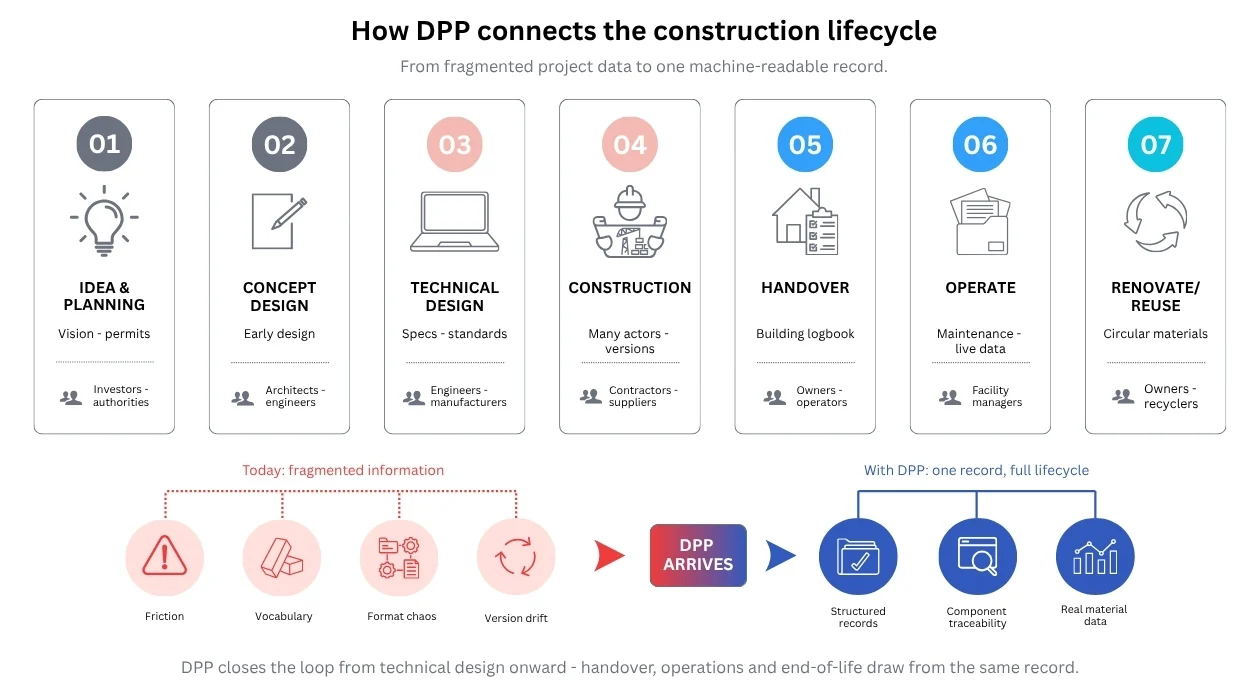
The process usually begins with the initial idea and planning phase. This stage includes planning, surveying, engineering studies, early design development, and obtaining permits. Based on this preparation, the concept design of the building begins. At this point, investors, architects, engineers, and sometimes public authorities start discussing the overall vision for the project.
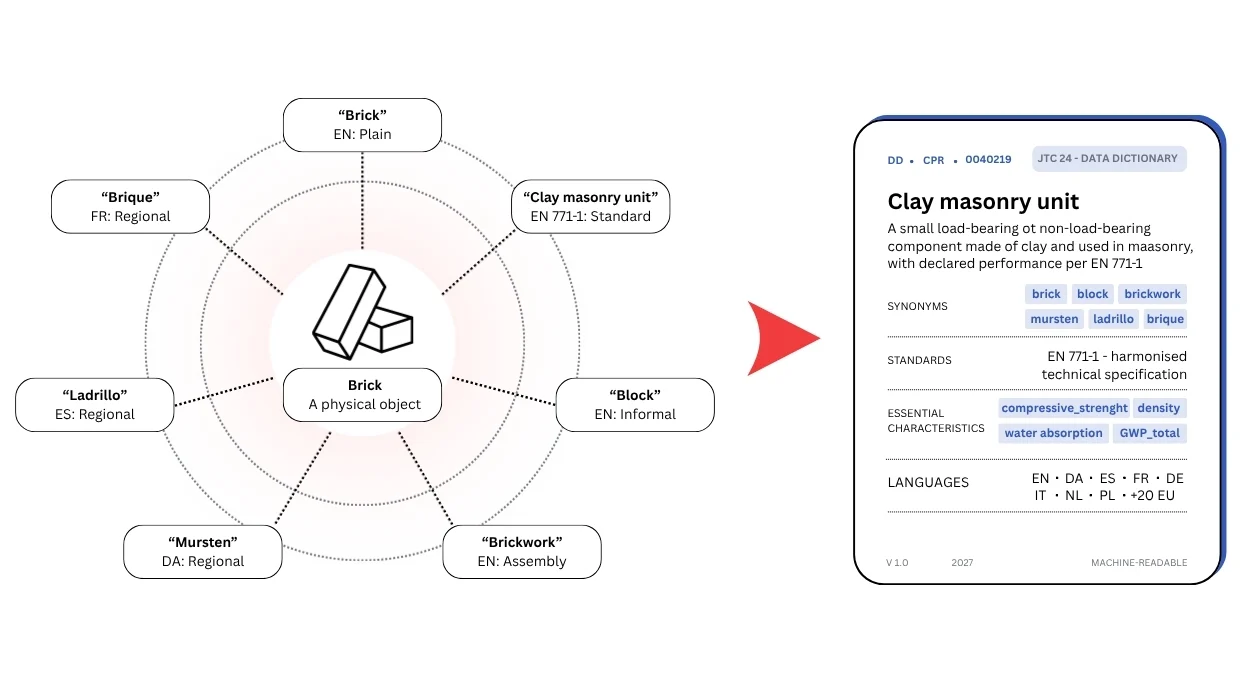
Even at this early stage, communication challenges can appear. For example, a simple building element such as a brick can be described in different ways: brick, clay masonry unit, block, or brickwork. While these words may refer to similar things, differences in terminology can create confusion when multiple stakeholders are involved.
As the project moves forward, the technical design stage begins. This is where the building and its components are specified in detail, to meet building codes, energy requirements, client requirements etc. At this point the lack of a common language becomes even more visible. Product information is often stored in various formats—PDF documents, spreadsheets, paper documentation, or proprietary software systems. Data may be digital, but it is often not machine-readable, which makes automated processing difficult.
When construction begins, the situation becomes even more complex. Additional actors enter the process, such as subcontractors and suppliers. Product data must be exchanged between many organizations in a fragmented suppluchain. Frequently, information is shared through multiple Excel files, email attachments, and PDFs. Different teams may work with different versions of the same documents, and it becomes difficult to know which version contains the most accurate information.
At the end of the construction process, all documentation must be handed over to the building owner or the organization responsible for operating the building. This information is crucial for facility management, maintenance, and future renovations. However, if the information was not collected and structured properly during the earlier stages, it becomes very difficult for building owners to use it effectively.
Finally, we must also consider the end of the building’s lifecycle. When a building is renovated or demolished, decisions need to be made about waste management, reuse of materials, and recycling. Without clear and reliable information about the materials used in the building, it becomes difficult to make environmentally responsible decisions.
This is where regulations such as CPR and ESPR become particularly important. If construction products are described using a common language, with harmonized methods for describing performance, and if this information is provided in structured, machine-readable digital formats, it becomes much easier for all actors to exchange and use data.
As a part of implementing the new ESPR, a set of standards has been developed in CEN-CENELEC JTC 24 committee. These standards define the technical backbone of the EU Digital Product Passport. This includes unique identifiers, data models, interoperability rules, APIs, data carriers (e.g. QR/RFID), and access control mechanisms. It is important to understand that ESPR and CPR are connected regulations, as ESPR is a horisontal implementation, and CPR is the regulation for placing construction products on the market.
In the summer of 2026 the European Commision launched the DPP Registry as a part of the roll out of ESPR, where Economic Operators can register their organisation Enrolment and to get verification and to register DPPs. The DPP Registry does not store the full DPP data. Instead, it records a subset of information necessary to identify and access the DPP, such as unique product identifiers and the location where the passport is hosted. The complete DPP data – including all product, sustainability, and compliance information – remains hosted and maintained by you, the economic operator (or a service provider you designate). You are responsible for ensuring its availability and accuracy throughout the DPP’s lifecycle, including any updates over time. Under delegated act CPR will implement DPP where the ESPR DPP Registry will be a step 1, and there will most probably be rules for DPP service providers under CPR.
While DPP is a gamechanger we often miss talking about Packaging and Packaging Waste Regulation, t is a major European Union law designed to reduce packaging waste, improve recycling, and promote a circular economy across member nations. This is an excample of why we need to think holisticly on how think about DPP, not for it to be a siloed concept.
When products are sold on the EU/EEA market, the users of products having a DPP will be able to identify the product who placed it on the market and where it is manufactured with identifiers like QR-codes, RFID etc. This will help actors to know what products are delivered to site.
In such a scenario, information could move smoothly between designers, contractors, manufacturers, and building owners, regardless of the software they use. The result would be a cleaner process, fewer mistakes, lower costs, and better outcomes for both the construction industry and the environment.
Understanding these regulations and the reasons behind them is an important first step toward improving the way we design, build, operate, and eventually recycle our buildings.
Construction products require a sector‑specific approach because they are products used in construction works such as buildings, bridges, roads and railways where product performance directly affects safety and regulatory compliance.
Under CPR, product performance is defined through essential characteristics described in harmonised technical specifications. Manufacturers must declare this performance through the Declaration of Performance and Conformity (DoPC). A significant innovation in the new CPR is that environmental performance data from Environmental Product Declarations. (EPDs) becomes part of the essential characteristics and must therefore be declared within the DoPC.
Manufacturers will therefore have a standardised framework for delivering information to a market under a regulatory framework, but also other relevant information outside the regulatory framework.
With the data carriers and the structured machine-readable data, both Manufactures and users of construction products will see great benefits and a simplification on how to deliver and use construction products for its intended use.
The European Union did a feasibility study published in 2026 to get input how a DPP system for construction products could be set up, to select the best option (centralized, service providers or stays with manufactures), and what digital standards that could be used for construction products under CPR. The first standardisation request under the new CPR was made for Cement, and it follows the recommendations in the feasibility study, referring to Data Templates. This is where market actors, governments and NGO need to build knowledge on the DPP for construction products. It can dramatically impact policies, investments, work processes, strategies and other high-level decisions.
Over the years we have seen the issues with data silos, manufacturers delivering data in hundreds of formats, data locked inside pdf-files. The new CPR now delivers a top-down policy, where product data will be machine readable and interoperable.
This transition moves the sector from document‑based (pdf) compliance toward data‑based compliance, allowing product information to flow directly into digital ecosystems such as Building Information Modelling (BIM), Building Logbooks, procurement systems and lifecycle asset management platforms.
Regulatory architecture can be understood as a simple stack: ESPR defines the EU framework, JTC 24 develops the digital standards, CPR implements the system for construction products and its digital standards for product data, and the DoPC becomes structured data feeding Digital Product Passports.
Why CPR and ESPR Matter for the Future of Construction